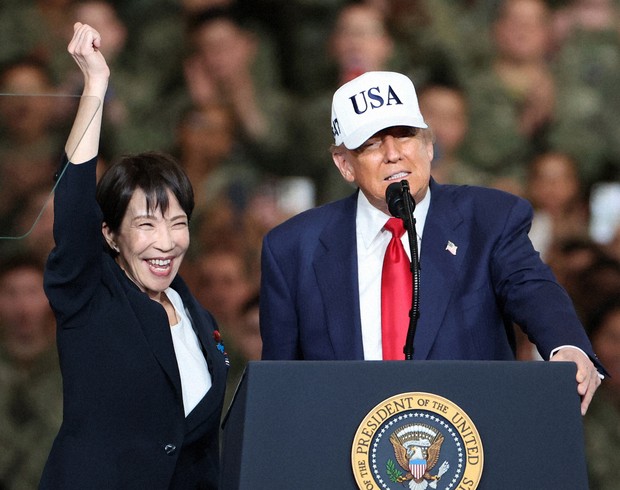
On January 2, 2026, U.S. President Donald Trump extended an invitation to Japanese Prime Minister Sanae Takaichi to visit the United States later this spring—a gesture that at first glance looks like standard diplomatic exchange. But this simple invitation is emblematic of far deeper currents shaping geopolitics today: the realignment of strategic partnerships, the commercial stakes in Indo-Pacific cooperation, and the widening contest with China for influence and economic leadership.
The Context: Beyond Formalities to Strategic Signalling
The call between Trump and Takaichi wasn’t a routine start-of-year greeting. It took place at a moment of heightened geopolitical tension in the Indo-Pacific, marked by rising Chinese military activity around Taiwan, large U.S. arms sales to Taiwan, and a re-energised Japan-U.S. security dialogue.
This invitation—likely to be timed in spring around Washington’s cherry blossom season—signals more than hospitality: it’s a renewed commitment to a bilateral alliance that now carries outsized weight in shaping regional stability and economic networks.
Who Gains—and Who Might Lose
Winners: Strategic Partners and Defense Industries
1. Japan and the U.S. Security Establishment
Both Tokyo and Washington benefit from reaffirming their alliance. For Japan, a strong partnership with the U.S. provides a security umbrella that deters coercion in regional flashpoints such as the Taiwan Strait. For the U.S., Japan serves as a cornerstone in a network of “like-minded” democracies—anchor states shaping collective responses to regional uncertainty.
Defense manufacturers on both sides stand to benefit as well. Elevated cooperation often translates into joint procurement programs, missile defense upgrades, and interoperability initiatives—all of which drive demand for military hardware and sustain high-value industrial supply chains.
2. Allied Economic and Supply Chain Actors
With strategic focus on a “Free and Open Indo-Pacific,” economic cooperation is likely to expand into industrial domains such as critical minerals, semiconductors and AI technologies—fields where U.S. and Japanese firms are global leaders. This can catalyse new cross-border investment flows and allied technology ecosystems that reduce overdependence on China.
Potential Losers: Beijing and Economically Entangled Actors
1. China’s Strategic Influence
A tighter Japan-U.S. alignment will likely exacerbate Beijing’s perception of encirclement, diminishing China’s leverage not just over Taipei, but over nations balancing economic ties with Beijing against security ties with Washington and Tokyo. China’s recent military exercises around Taiwan indicate Beijing’s sensitivity to such shifts.
2. Industries Caught Between Competing Blocs
Companies and markets deeply integrated with both China and the U.S. face a dilemma. Global supply chains for electronics, rare earths and automotive components may find themselves at the intersection of competing regulatory regimes or new economic decoupling pressures—potentially disrupting existing commercial relationships.
Broader Business and Market Impacts
Trade Patterns and Investment Flows
The Japan-U.S. security engagement almost always carries an economic dimension:
- Energy markets: Japan may consider diversifying its energy import strategy, potentially increasing LNG and other U.S. energy product purchases.
- Automotive industries: There may be greater U.S.-Japan collaboration on electric vehicles and related infrastructure, rebalancing trade in key sectors.
Collectively, these shifts can influence currency markets, investment allocations, and international trade balances as companies orient toward secure, allied supply chains rather than cost-only optimization.
Long-Term Geopolitical and Economic Effects
1. Shift Toward Multi-Polar Diplomacy in Asia
Indo-Pacific cooperation today isn’t a bilateral phenomenon. It extends to trilateral and quadrilateral frameworks involving South Korea, Australia, India, and others. Strengthened Japan-U.S. ties may serve as a keystone for broader regional architecture that balances China’s influence without direct containment.
2. Strategic Economic Realignment
As the U.S. and Japan deepen cooperation, we may see:
- Cross-national R&D initiatives
- Coordinated export controls on sensitive technologies
- New frameworks for critical mineral sourcing
These developments could restructure global technology markets over the next decade, shaping competitive landscapes in semiconductors, artificial intelligence and clean energy.
Hidden Implications: Domestic Politics and Diplomatic Labyrinths
Japan’s Prime Minister Takaichi brings a different political background compared to her predecessors. Her security posture has drawn sharp responses from Beijing in the past—and her close alignment with the U.S. could intensify those dynamics.
Domestically, this alignment challenges Japan’s longstanding strategic ambiguity on issues like Taiwan. It also underscores the growing expectation that democratic allies must not only defend territory but also uphold shared economic and normative interests. This represents a significant shift in Japanese foreign policy thinking, with ramifications for everything from defense budgets to trade negotiations.
Conclusion: Invitation as Pivot Point
The U.S. invitation to Japan’s prime minister is not merely diplomatic courtesy. It is a strategic pivot in a rapidly reconfiguring world, where alliances are currency, and stability in the Indo-Pacific is the prize. The effects will ripple across defense industries, trade flows, political alignments and economic ecosystems—redefining what “like-minded cooperation” means in practice.
For investors, policymakers and businesses alike, this moment underscores a basic strategic truth: geopolitics and economics are increasingly inseparable, and the architecture of cooperation we build now will determine prosperity in the decades ahead.


![# Why India’s Stock Market Is at a Turning Point — and What It Means for 2026 Recent data points show Indian equity markets poised for a potential rebound — with benchmark indices likely to open higher on optimism around corporate earnings growth. That’s not just a short-term mood boost: it reflects deeper shifts in how investors are valuing India’s economic momentum as the new year begins. ([Reuters][1]) But beyond the surface bump in futures, the evolving narrative of Indian markets tells a story of **winners and losers, cross-currents in flows, and risks that could shape finance and business well into 2026**. --- ## 📈 The Bulls: Domestic Growth and Earnings Momentum **Why optimism is rising** After a subdued 2025 — when India’s equities lagged global peers despite strong macro data — analysts increasingly point to earnings as the driver of the next leg up. Corporate profits have started to improve across sectors, and futures pricing indicates that benchmarks could open higher, even as heavyweights like Reliance Industries and HDFC Bank temper gains. ([Reuters][1]) Broader forecasts outside the immediate news support this view. Brokerages such as Jefferies and Morgan Stanley see profit per share growth accelerating in FY27 and beyond, with key sectors like banking, autos and telecom leading the charge. Some projections even envisage **double-digit EPS growth** as a foundation for fresh market advances. ([ETCFO.com][2]) **Who benefits** * **Corporate India with strong domestic demand:** banks, automobiles, telecom companies and consumer discretionary players are set to reap gains from improving sales and margins. * **Domestic institutional investors:** with foreign flows fickle, robust month-by-month inflows from mutual funds, pension funds and insurance investors help underpin prices and limit volatility. ([ETCFO.com][2]) * **Mid- and small-caps (conditional):** these segments may benefit if earnings trends broaden beyond blue-chips, though valuations and liquidity still matter. --- ## 🧠 A Cautionary Signal: Foreign Investors and External Risks **Foreign money remains a mixed story** While domestic flows are structurally strong, foreign institutional investors (FIIs) have been selling Indian equities for much of 2025. That pattern has left India’s market ownership among the lowest levels in years — a vulnerability if earnings disappoint or global risk aversion rises. ([Business Recorder][3]) Trade tensions with the U.S., particularly over tariffs and energy imports, have also clouded sentiment, capping gains despite stronger earnings figures. Geopolitical influences aren’t short-term headlines: they shape how willing international capital is to commit long-term. ([Reuters][4]) **What this means long-term** * **Volatility could persist.** India’s stock market might keep oscillating with foreign investor sentiment even if domestic fundamentals strengthen. * **Sectoral divergence.** Export-oriented and globally sensitive sectors (IT or pharma) may underperform versus domestic demand plays. --- ## 📊 Macro Fundamentals Still Matter India’s broader economy remains a key driver of market prospects: * Long-term growth forecasts remain robust, with GDP expected to stay near or above ~7% in FY27. ([The Times of India][5]) * Inflation and interest rate trajectories will influence corporate cost structures and valuations. * Policy reforms — such as GST adjustments, potential trade deals and infrastructure incentives — could make earnings more predictable. These factors contribute to the idea that **2026 could mark not just a bounce but a structural phase in market evolution** where earnings, not liquidity, dictate valuations. ([Fortune India][6]) --- ## 🧩 Hidden Implications: Currency & Foreign Exchange Another critical piece rarely highlighted in headlines is the currency picture. The Indian rupee has shown volatility against a strengthening dollar, partly due to global rates and capital flows. Central bank intervention offers some support, but a weaker currency can squeeze corporate profits, especially for import-dependent firms. ([Reuters][7]) **Why this matters** * **Exporters can gain cost competitiveness**, potentially boosting earnings. * **Import-reliant sectors face margin pressure**, damping enthusiasm among investors. * For foreign investors, currency risk overlays equity return prospects — influencing allocation decisions. --- ## 📅 What’s Next: Scenarios to Watch in 2026 ### Winning outcomes * **Sustained earnings acceleration** across sectors * **Return of foreign capital** with clearer global trade dynamics * **Policy clarity on trade and tax reforms** ### Challenges * **Global macro shocks** (e.g., slowing U.S. growth, oil price spikes) * **Domestic inflation surprises**, forcing tighter policy * **Unresolved geopolitical tensions** For investors and business leaders alike, 2026 is shaping up not as a simple continuation of 2025, but as a **pivotal transition**: where profit performance, capital flows and global linkages interact to define long-term direction. --- In short, the current optimism in Indian markets is not just fleeting anticipation of quarterly numbers — it reflects deeper realignments that could influence investment strategies, corporate planning and the broader economic narrative for the year ahead. [1]: https://www.reuters.com/world/india/indian-shares-likely-open-higher-earnings-growth-optimism-2026-01-06/?utm_source=chatgpt.com "Indian shares slip from near record highs as Reliance, HDFC Bank weigh" [2]: https://cfo.economictimes.indiatimes.com/news/jefferies-says-indian-shares-set-for-better-2026-on-earnings-domestic-flows/125928841?utm_source=chatgpt.com "Indian Shares to Prosper by 2026: Jefferies Anticipates Earnings Surge and Strong Domestic Flows, ETCFO" [3]: https://www.brecorder.com/news/40400840?utm_source=chatgpt.com "Indian shares likely to open higher on earnings growth optimism - Markets - Business Recorder" [4]: https://www.reuters.com/world/india/indian-equities-open-flat-geopolitical-tensions-offset-earnings-optimism-2026-01-07/?utm_source=chatgpt.com "Indian shares decline as geopolitical tensions overshadow earnings optimism" [5]: https://timesofindia.indiatimes.com/business/india-business/india-growth-outlook-economy-may-grow-6-9-in-fy27-goldilocks-phase-likely-to-continue/articleshow/126371536.cms?utm_source=chatgpt.com "India growth outlook: Economy may grow 6.9% in FY27; 'Goldilocks' phase likely to continue" [6]: https://www.fortuneindia.com/markets/market-outlook-2026-earnings-domestic-demand-to-power-next-leg-of-sensex-nifty/129179?utm_source=chatgpt.com "Market outlook 2026: Earnings, domestic demand to power next leg of Sensex, Nifty" [7]: https://www.reuters.com/world/india/rbi-support-cushion-india-rupee-downside-amid-asia-softness-2026-01-07/?utm_source=chatgpt.com "RBI support to cushion India rupee downside amid Asia softness"](https://deshtimestv.com/wp-content/uploads/2026/01/Why-Indias-Stock-Market-Is-at-a-Turning-Point-—-and-What-It-Means-for-2026-150x150.jpg)

